DLP Is Not a Warranty Period, It’s a Governance Window
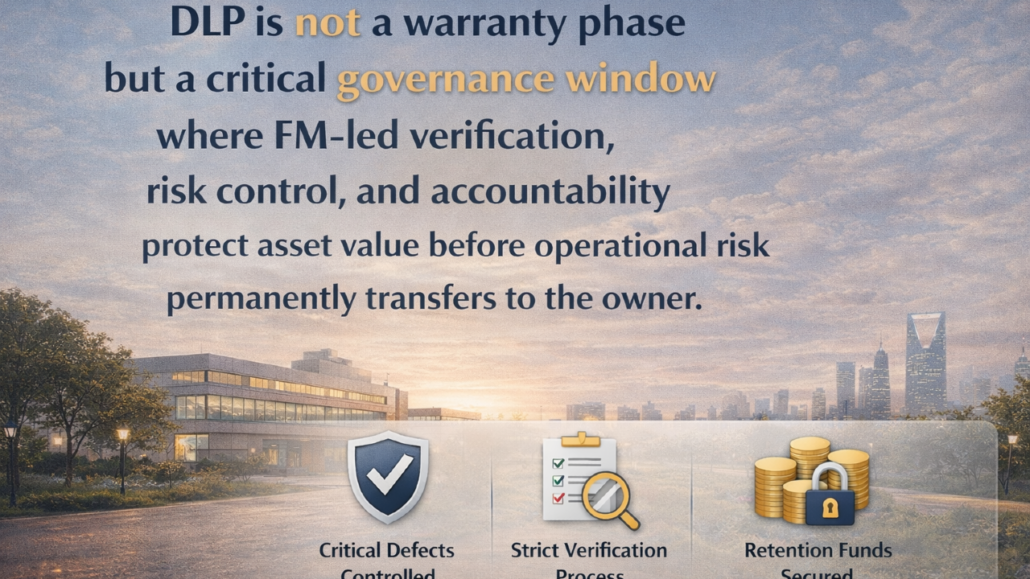
Most organizations treat the Defects Liability Period (DLP) as a contractor close-out formality. In reality, DLP is the most commercially sensitive window of the asset lifecycle: the period where latent design gaps surface under live operations, reputational risk is highest, and the cost of poor documentation becomes visible. The winners are not the teams who “log defects” — but the teams who govern them: controlling prioritization, access, evidence, safety, user impact, and contractual accountability. DLP is not a technical phase. It is an operational governance phase, and Facility Management is the function best positioned to convert it into measurable asset value protection.
Defining DLP Correctly: Beyond the Myth
The Defects Liability Period (also known as the rectification period) commences after Practical Completion and typically runs for a contractually defined duration of 6 to 24 months, depending on the project particulars and contract form employed. According to RICS guidance on defects and rectifications, this period serves as the formal contractual mechanism for identifying and rectifying defects that emerge as buildings transition from commissioning into live operational use.
The prevailing misconception is that once DLP expires, all liability ceases. This is fundamentally incorrect. As legal guidance from Pinsent Masons clarifies, while DLP establishes a structured window for defect identification and rectification, broader legal liabilities — particularly for latent defects, design failures, and fitness-for-purpose claims — can extend well beyond this period depending on contract terms, statutory limitations, and the nature of the defect itself. The DLP is a commercial mechanism for managing known and emerging defects systematically; it is not a liability firewall.
What makes DLP operationally critical is timing: it represents the first sustained period where design assumptions meet operational reality. Systems are loaded, spaces are occupied, environmental controls are stressed, and user behaviors introduce variables that no commissioning protocol can fully replicate. This is when procurement decisions, design compromises, and installation shortcuts reveal themselves — often simultaneously.
Why FM Must Own the DLP Control Tower
Facility Management sits at a unique operational intersection during DLP. FM is the only function that simultaneously observes live operational impact (safety events, downtime, user complaints), monitors asset performance trends under real demand profiles, controls access coordination and work permits, and maintains accountability for contractual closure discipline. This convergence of operational visibility, stakeholder management, and commercial awareness makes FM the natural governance lead for DLP.
Consider the operational reality: a defect identified during DLP is rarely “just” a defect. It is a service continuity risk, a safety exposure, a user experience failure, and a contractual liability — often all at once. The University of Oxford’s Soft Landings handbook explicitly recognizes this complexity, noting that aftercare responsibilities extend through the DLP window and require structured contractor engagement, responsive key-holder protocols, and documented handback procedures. Academic research on transition-to-operations phases similarly frames the period from Practical Completion to the end of DLP as fundamentally operational in character, not administrative.
Without FM-led governance, DLP defaults to reactive firefighting: defects are logged inconsistently, evidence quality varies wildly, prioritization becomes political, access coordination creates operational disruption, and commercial closeout stalls because verification standards were never defined. The result is value erosion: retention funds released prematurely, repeat defects that could have been prevented, operational risks transferred back to the owner, and stakeholder confidence undermined.
Measured Outcomes (DLP Performance Indicators):
- Critical defect closure time reduced by approximately 30–40% through risk-based triage and verification gates.
- Repeat defects reduced to below 5%, driven by root-cause verification and independent FM sign-off.
- Zero unplanned, defect-related operational interruptions recorded throughout the DLP window.
- Retention release aligned exclusively with verification-backed defect closures, eliminating calendar-driven commercial exposure.
Case Study: Civil Defense Center, Riyadh Diplomatic Quarter
When I assumed responsibility for the Civil Defense Center handover within Riyadh’s Diplomatic Quarter, the stakes were immediate and unforgiving. This was not a speculative office building or retail environment where operational ramp-up could be gradual. This was a high-sensitivity operational facility where response readiness, system reliability, regulatory compliance, and stakeholder confidence were non-negotiable from day one.
The DLP risks were not confined to cosmetic finishes or minor mechanical adjustments. They represented operational exposure: could emergency response systems be relied upon? Would access constraints during rectification work compromise service continuity? How would defect-related downtime be explained to stakeholders with zero tolerance for disruption? The conventional “punch-list” mindset was inadequate for this context.
We implemented a structured DLP command structure with three core components:
First, a centralized intake and triage cell. All defects — regardless of source or perceived severity — were logged through a single intake process with mandatory evidence requirements: time-stamped photographs, operational readings, commissioning baseline comparisons, and detailed location/system references. This eliminated opinion-based reporting and created an auditable defect registry.
Second, a defect heatmap and classification framework. We categorized every defect across two dimensions: operational criticality (life-safety, business-critical, performance-impacting, cosmetic) and system interdependency. This forced prioritization based on risk, not volume or contractor convenience. Life-safety defects triggered 24-hour resolution protocols. Business-critical items were escalated to weekly governance forums. Everything else was scheduled within controlled access windows to minimize operational disruption.
Third, verification-based closeout gates. No defect could be closed without documented verification under live or live-like operational conditions. Contractors could not self-certify. FM conducted independent verification tests, reviewed evidence against acceptance criteria, and formally signed off closure. This single control prevented the majority of repeat defects and ensured that rectification work actually resolved the underlying failure, not just the visible symptom.
The governance structure also included controlled access windows negotiated with operational teams, weekly DLP review meetings with clear RACI accountability, and explicit linkage between defect closure and commercial retention release. We reframed the language: this was not “snagging” — it was risk closure and license-to-operate protection.
The results were measurable. Critical defect closure timelines were reduced significantly, repeat defects dropped as root-cause verification became standard, and most importantly, we experienced zero unplanned operational interruptions during the entire DLP window. Stakeholder confidence — both internal and external — was preserved because the governance model created transparency, predictability, and accountability.
The DLP Operating Model: What “Good” Looks Like
A mature FM-led DLP governance model operates across five integrated control layers:
Defect Taxonomy and Classification
Establish a clear hierarchy: life-safety (immediate), business-critical (48-hour SLA), performance-impacting (scheduled within access windows), cosmetic (batched). Classification drives response protocols, escalation paths, and verification requirements. Avoid the trap of treating all defects as equal priority.
Evidence Standards and Documentation Protocols
Define minimum evidence requirements before a defect can be logged: photographic evidence with metadata, baseline readings from commissioning, operational logs demonstrating impact, and precise location/system identification. Poor evidence quality is the root cause of most DLP disputes and repeat defects.
Defect Workflow with Clear Handoffs
Report → Triage (FM) → Instruct (Commercial/Contracts) → Access Plan (FM/Operations) → Rectify (Contractor) → Verify (FM) → Close (Commercial). Each stage has defined ownership, timing expectations, and hold-points. Weekly governance meetings track status, resolve blockages, and escalate stalled items.
Performance Metrics and Visibility
Track time-to-triage (target: 48 hours), time-to-rectify by classification tier, repeat defects rate (target: <5%), life-safety closure SLA compliance (target: 100%), and commercial closeout completion percentage. Publish weekly dashboards visible to project leadership and contractor senior management.
Commercial Controls and Retention Alignment
Tie retention release to verified defect closure milestones, not calendar dates. Implement “no-close without verification” protocols. Use defect trends to inform final account negotiations and validate warranty exclusions. Ensure that the commercial team cannot authorize final payment until FM confirms operational acceptance.
Organizations can assess their DLP maturity across a simple ladder:
Reactive: Defects logged inconsistently, no prioritization framework, contractor self-certification, ad hoc access
Managed: Centralized defect log, basic classification, some evidence standards, scheduled reviews
Governed: Risk-based prioritization, mandatory evidence protocols, verification gates, KPI tracking, weekly forums
Optimized: Predictive defect analysis, continuous improvement loops, integrated with asset lifecycle data, benchmarked performance
Most organizations operate between Reactive and Managed. The commercial value gap between Managed and Governed is substantial.
Why This Matters: The Hidden Costs of Weak DLP Governance
DLP is where asset value is protected or eroded. When defects are poorly governed, three categories of hidden cost accumulate rapidly:
Operational costs: Unplanned downtime from defect-related failures, safety incidents from unresolved hazards, productivity loss from environmental comfort issues, user dissatisfaction affecting retention and reputation.
Commercial costs: Retention released prematurely, final accounts settled without leverage, warranty exclusions accepted without challenge, consultants’ fees defending poorly documented defect claims.
Lifecycle costs: Repeat defects creating maintenance backlog, asset performance degradation from unresolved commissioning gaps, capital renewal advanced because rectification windows were missed, lost operational data for future design benchmarking.
PwC’s legal guidance on DLP emphasizes that the period serves not just as a defect rectification window, but as a dispute avoidance mechanism — provided it is managed with appropriate rigor and documentation discipline. The absence of governance converts DLP from a risk mitigation tool into a risk creation exercise.
FM-Led DLP: The 10 Controls That Prevent Value Erosion
Organizations seeking to elevate DLP governance should implement these foundational controls:
Single intake process
All defects logged through one channel with mandatory evidence requirements
Risk-based classification
Life-safety / business-critical / performance / cosmetic hierarchy with defined SLAs
Triage cell with FM ownership
Centralized review, validation, and prioritization within 48 hours
Verification-before-closure gate
No contractor self-certification; FM conducts independent testing and sign-off
Controlled access windows
Rectification work scheduled to minimize operational disruption; FM approves all access
Weekly governance forum
Cross-functional review with RACI clarity, published dashboards, escalation protocols
Defect heatmap and trend analysis
Visual prioritization tool; identify systemic failures and contractor performance patterns
Commercial-retention linkage
Retention release tied to verified closure milestones, not expiry dates
Repeat defect protocol
Root-cause investigation triggered after second occurrence; contractor action plan required
Handback verification checklist
Final DLP closeout cannot proceed until FM certifies operational acceptance against defined criteria
Conclusion: DLP as Strategic Governance, Not Administrative Cleanup
The Defects Liability Period is not a warranty extension or a contractor grace period. It is the most commercially sensitive window of the asset lifecycle — the period where design intent confronts operational reality, where stakeholder trust is won or lost, and where the cost of poor governance becomes immediately visible.
Facility Management is uniquely positioned to lead this phase because FM operates at the intersection of technical performance, operational continuity, user experience, and commercial accountability. When FM governs DLP with appropriate rigor — evidence-based classification, verification protocols, access control, performance tracking, and commercial discipline — the result is measurable value protection: faster defect resolution, reduced repeat failures, preserved operational continuity, and stakeholder confidence.
When FM abdicates this responsibility, DLP becomes a reactive exercise in firefighting, dispute escalation, and value erosion. The choice is structural: govern DLP as an operational risk management program, or accept it as an administrative legacy that erodes asset value and transfers risk back to the owner.
The governance infrastructure is not complex. The commitment required is leadership clarity that DLP is not a technical handover formality — it is an operational governance mandate, and Facility Management owns the outcomes.
01/02/2026
Yasser Zakaria